Many incident recovery plans end with one sentence: "the servers are back up". Boston Scientific's cybersecurity incident in August 2026 shows why that sentence is not enough. There was no evidence of data encryption and no evidence of data theft, yet the company's ability to manufacture, process, and ship orders was disrupted globally for about two weeks.
Boston Scientific makes medical devices such as implantable cardiac devices. Throughout the incident it published public updates, filings with the US Securities and Exchange Commission (SEC), and an investigation summary from CrowdStrike. This article summarises the facts from those primary documents, then turns them into practical steps for hospitals, distributors, manufacturers, and logistics operators in Indonesia.
Recovery is finished when orders, shipments, and patient services are back to normal, not when the servers are back on.
What happened
According to Boston Scientific's 26 August 2026 update, the company identified a cybersecurity incident on 25 August 2026 that caused a network outage and disrupted operations. Access to certain operating systems and business applications was affected, including the ability to process and ship customer orders.
The Form 8-K filed with the SEC (date of report 7 September 2026) describes the incident as a "global disruption" to operations that affected the company's ability to manufacture as well as process and ship orders.
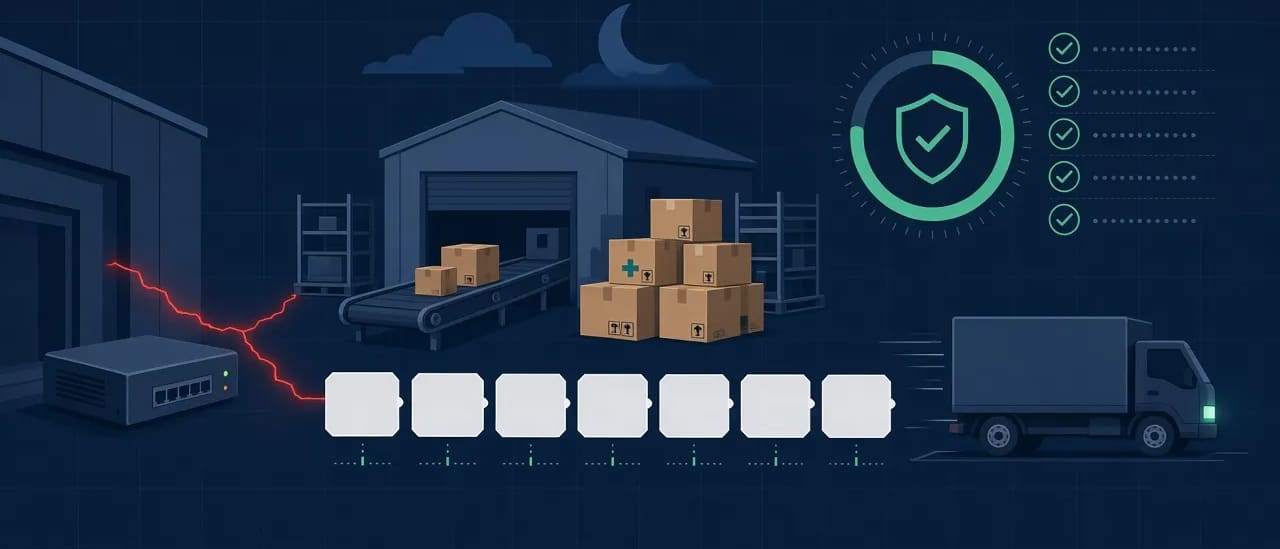
One detail stands out. During the disruption, according to the 3 September 2026 update, customers could still submit orders electronically through EDI (electronic data interchange) and local applications. Those orders were placed in a queue for later fulfilment. The order intake path stayed alive while processing and shipping stopped.
The disruption also reached patient services. The same update said there was no known impact on the function of cardiac devices already implanted. However, remote monitoring could not be activated for new implants, so data from new devices was not transmitted to the monitoring system until activation was restored.
Short timeline
| Date (2026) |
Event according to primary sources |
| 25 August |
Incident identified; network disrupted, order processing and shipping affected |
| 3 September |
Shipping begins to be restored for most products at major distribution centres, as capabilities are validated |
| 7 September |
Form 8-K: major distribution centres processing orders at or above normal levels; sterilisation facilities operational; manufacturing resumed at most facilities |
| 9 September |
Manufacturing, order fulfilment, and shipping declared fully restored; remote monitoring activation restored |
| 22 September |
CrowdStrike investigation summary published |
The way in: a network device facing the internet
The CrowdStrike investigation summary says the investigation ran from 25 August to 18 September 2026. The threat actor gained access through an external-facing network management device, and subsequent access was limited to a portion of the on-premises environment.
CrowdStrike found no evidence of data encryption, no threat actor activity in Microsoft 365 and email, and no evidence that data was accessed, staged, or exfiltrated from the systems examined, including customer and patient data. Manufacturing, medical device maintenance, SCADA, and software development systems, as well as financial systems such as Salesforce and SAP, also showed no evidence of access.
The containment actions recorded are straightforward: the entry device was disconnected and decommissioned, the actor's IP addresses and domains were blocked at the firewall, passwords were reset, and the affected environment was hardened. Security monitoring was also expanded.
Lessons that apply to anyone
1. Operations can stop even without encryption. Many organisations assess cyber risk in terms of ransomware or data leaks. This case shows that a network outage across on-premises systems is enough to halt core processes. The impact is real: the Form 8-K states the incident is likely to have a material impact on third-quarter and full-year 2026 results, and that the company is unlikely to meet its previously issued net sales growth guidance.
2. Devices at the network edge are critical assets. VPNs, firewalls, and network management interfaces are often installed once and rarely touched. That is exactly where this incident began.
3. Restore in stages, with validation. The 3 September update says shipping was reopened "as capabilities are validated". That order is safer than switching everything on at once.
4. Technical recovery is not business recovery. After shipping was fully restored on 9 September, the company still said some customers might see temporary delays as the order backlog was worked through, and certain business applications were still being restored one by one.
5. Evidence decides how quickly you can reassure partners. The statement that SCADA, email, and financial systems were not touched could only be made because there were records (logs) to examine. Without logs, the honest answer is "we don't know".
What it means for organisations in Indonesia
Hospitals running an on-premises hospital information system (SIMRS), pharmaceutical wholesalers and distributors with their own warehouses and ERP, factories, and logistics operators share a similar pattern: many core processes still run in their own server rooms, with a VPN or firewall as the gateway from outside. Here are five steps you can start this month.
- Inventory your edge devices. List every VPN, firewall, router, and management interface reachable from the internet, with firmware version, owner, and vendor support status. Close management interfaces to the internet and require MFA.
- Define a fallback mode per process. For each core process (patient registration, order intake, goods dispatch), decide what keeps running when the main system is down: an electronic queue, paper forms, or a manual procedure, and who re-enters the data afterwards.
- Measure recovery in business numbers. Beyond "the system is up", track orders processed per day, the age of the oldest item in the queue, and the gap between orders received and goods shipped.
- Make sure your logs can answer "what was not touched". Keep logs from edge devices, authentication, and core applications in a separate place with a clear retention period.
- Prepare partner communication. An update page, an FAQ, and a contact list of key customers and suppliers. Boston Scientific updated its page many times; customers who were waiting knew what they could and could not do.
If your organisation provides public services, our article on forming a CSIRT and the BSSN warnings is a relevant next step. For infrastructure resilience, see also redundancy lessons from the Google Cloud incident.
Where MarkasDev can help
Steps 1 and 2 fit well as a Diagnose engagement: mapping edge devices, process dependencies, and fallback modes, with written findings. Running monitoring, device patching, and recovery tests on a regular basis is the core of Operate, with an SLA and periodic reports.
Limits
This article relies only on documents published by Boston Scientific, its SEC filing, and the CrowdStrike summary. We do not guess the identity of the threat actor, the type of device vulnerability, or the size of the financial loss, because the primary sources do not state them.
Start with one question
If your VPN gateway had to be shut down tonight, which processes would stop tomorrow morning, and how would orders or patients still be served? Request a Diagnose via the contact page, and we will help you map it before an incident forces the question.
Sources
- Boston Scientific, Archived update on cybersecurity incident (26 August 2026): https://news.bostonscientific.com/8-26-26-cyber-update-archive
- Boston Scientific, Archived update on cybersecurity incident (3 September 2026): https://news.bostonscientific.com/9-3-26-cyber-update-archive
- Boston Scientific, Form 8-K Item 1.05 (date of report 7 September 2026): https://www.sec.gov/Archives/edgar/data/885725/000088572526000059/bsx-20260907.htm
- Boston Scientific, Archived update on cybersecurity incident (9 September 2026): https://news.bostonscientific.com/9-09-26-cyber-update-archive
- Boston Scientific, Update on the August 25 cybersecurity incident (22 September 2026): https://news.bostonscientific.com/update-on-recent-cybersecurity-incident
- CrowdStrike Services, Investigation Summary for Boston Scientific (22 September 2026): https://filecache.mediaroom.com/mr5mr_bostonscientific/208705/download/Crowdstrike%20Investigation%20Summary%20%289.22.2026%29.pdf