Redundancy is often sold as insurance: two paths, two routers, two zones, so one failure will not be felt. Google Cloud's incident on 1 September 2026 shows a gap rarely discussed in budget meetings. Redundancy only works if the procedures that touch it cannot remove all of it at once.
Google published a full incident report on 10 September 2026 and an addendum on 29 September 2026. The content is candid and worth studying for anyone who runs critical systems, whether in the cloud, in colocation, or in their own server room. This article summarises the facts from that primary report and turns them into steps for organisations in Indonesia.
Redundancy that one work instruction can remove is not redundancy. It only looks redundant on the diagram.
What happened
According to the Google Cloud Service Health page, on Tuesday 1 September 2026 some customers in the us-central1 region experienced network service degradation and instance isolation for 4 hours 11 minutes, from 07:41 to 11:52 Pacific time (about 21:41 to 01:52 the next day in Jakarta, WIB).
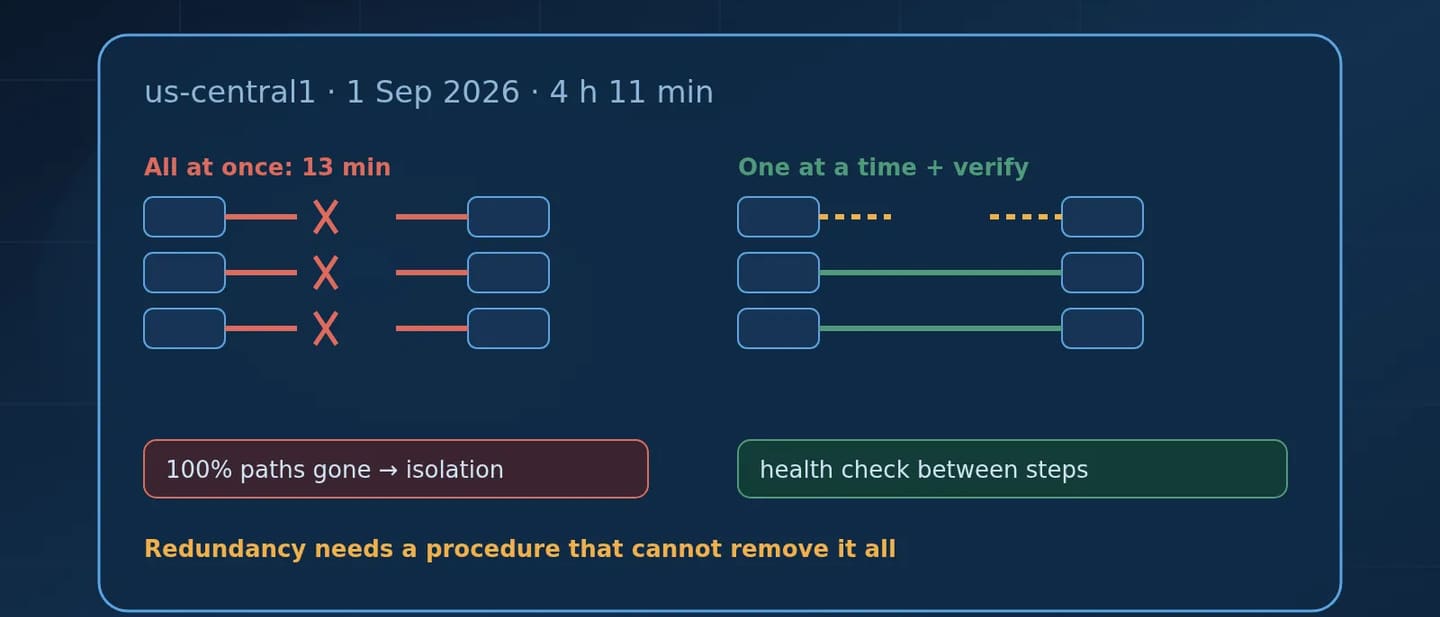
The trigger was the inadvertent physical disconnection of fibre-optic cables during routine hardware maintenance. A technician was carrying out a capacity upgrade on data-centre routers. The network is designed with redundant routers in separate data-centre rooms in the same building, so that one router failing does not interrupt service. The maintenance was supposed to go one router at a time over several days, with traffic diversion and verification at each step.
The opposite happened. According to Google, a procedural error in the manually orchestrated upgrade process meant the full list of transceiver replacements across all routers was given to the technician without instructions to sequence the work one router at a time. The workflow also lacked the human and software verification steps expected to detect unintended disruption. As a result, all fibre paths across the affected devices were unplugged in sequence within 13 minutes. Warnings never reached the technician in time, and the standing procedure to halt if light is still detected on a cable after unplugging was not followed.
The impact: traffic-flow drop rates reached 100 percent at the peak, virtual machines became unreachable, and many products were affected, from Compute Engine and Cloud SQL to GKE.
The 29 September addendum: impact spread
In the 29 September 2026 addendum, Google explained that regional products depending on the affected data centre were also disrupted, including several types of load balancer and hybrid connectivity. There was also a knock-on effect in Cloud Run and App Engine: once the cluster recovered, a surge of simultaneous instance initialisations (a thundering herd) overloaded the file-serving tier and prolonged symptoms until emergency capacity was provisioned. In this incident, recovery created new problems; it needs to be planned as seriously as prevention.
Who came through
Google states that correct multi-zone deployments, spread across other zones in the same region, were largely able to bypass this hardware failure and keep serving traffic. Customers with resources in the affected clusters lost connectivity completely. The practical message: your design decides, not the name of the provider.
Google's fixes make a checklist
Google lists four preventive actions:
- Refresher training on safe maintenance technique, including the mandatory requirement to verify whether light is present on every unplugged fibre.
- Finishing the migration of network-upgrade workflows to an automatically sequenced orchestration system. Most common regional workflows were completed in 2025; zonal workflows are in progress.
- Work-stop alerting for actions that unintentionally disconnect live fibre.
- An automated system that moves regional traffic away from a faulty zone, cutting the time from about 19 minutes in this case to about 5 minutes.
In our view, this is not unique to Google. The same pattern applies to database updates, bulk firewall changes, or server patches rolled out to the whole fleet at once.
What this means for organisations in Indonesia
This section is our interpretation of Google's report.
Hospitals, regional banks, and logistics firms that place core systems in a single zone or a single server room should check one thing before any other: if every path to that zone disappears at once, what happens to your service? If the answer is "we have never tested it", that is a finding.
Local governments and regional enterprises that depend on colocation or managed-service providers should ask the provider to explain how they sequence maintenance work, including verification between steps and impact limits for bulk changes. This question belongs in SLAs and maintenance schedules.
Internal teams should apply the same thinking to their own changes. A patch run on all servers at once, or a script that applies configuration to every node, turns your spare capacity into one fate-shared unit.
One honest note: multi-zone does not help if your own application only runs in one zone. Google's report shows that those who came through were deployments that were already spread out.
The same lesson at the AI layer
On 3 September 2026, according to a Cloud Security Alliance research note, three leading conversational AI services suffered overlapping disruptions within the same three-hour window. Each provider cited a different cause or had not explained it, and the note says no shared cause has been confirmed. It also states that it was generated with AI assistance and has not undergone official CSA review, so we use it only for the general picture.
Its recommendations resemble the lessons above: inventory the processes that depend on AI providers (including AI embedded in third-party software), monitor the AI endpoints you use independently, and prepare a fallback path that is actually tested, not just a router with nowhere to route to.
Five steps this week
- Map single points. For each critical service: one zone, one provider, one person, or one script that can affect all of its instances?
- Sequence bulk changes. Apply to one node or one zone first, check health, then continue. Write down a limit per step.
- Add checks between steps. Clear pass criteria, and authority for anyone who spots an anomaly to stop the work.
- Test real failover at least once a year, including staged recovery so it does not trigger a simultaneous surge.
- List external dependencies, including AI services in use, with their incident contacts and fallback plans.
Steps 1 and 4 are Diagnose work that produces written findings. Keeping change discipline and monitoring going afterwards is the core of Operate. If you need servers and application environments set up with scheduled patches and verified backups, see our server and environment service.
Limits
We rely only on the Google Cloud status page as the primary incident source, and on the CSA note for the AI events. We do not assess any specific customer's architecture, calculate financial loss, or claim that other providers are free of similar risk.
Start with one question
If every path to one zone disappears tonight, which services stop, and who knows the first step? We can help map it before a large budget is locked in. Request a Diagnose via the contact page.
Sources
- Google Cloud Service Health—Incident J5ia5t9p3g9Q5Wi7r8Ev (10 September report and 29 September 2026 addendum): https://status.cloud.google.com/incidents/J5ia5t9p3g9Q5Wi7r8Ev
- Cloud Security Alliance—The Triple AI Outage: A Wake-Up Call for AI Continuity (19 September 2026): https://labs.cloudsecurityalliance.org/wp-content/uploads/2026/09/CSA_research_note_triple_ai_outage_concentration_risk_20260919-csa-styled.pdf