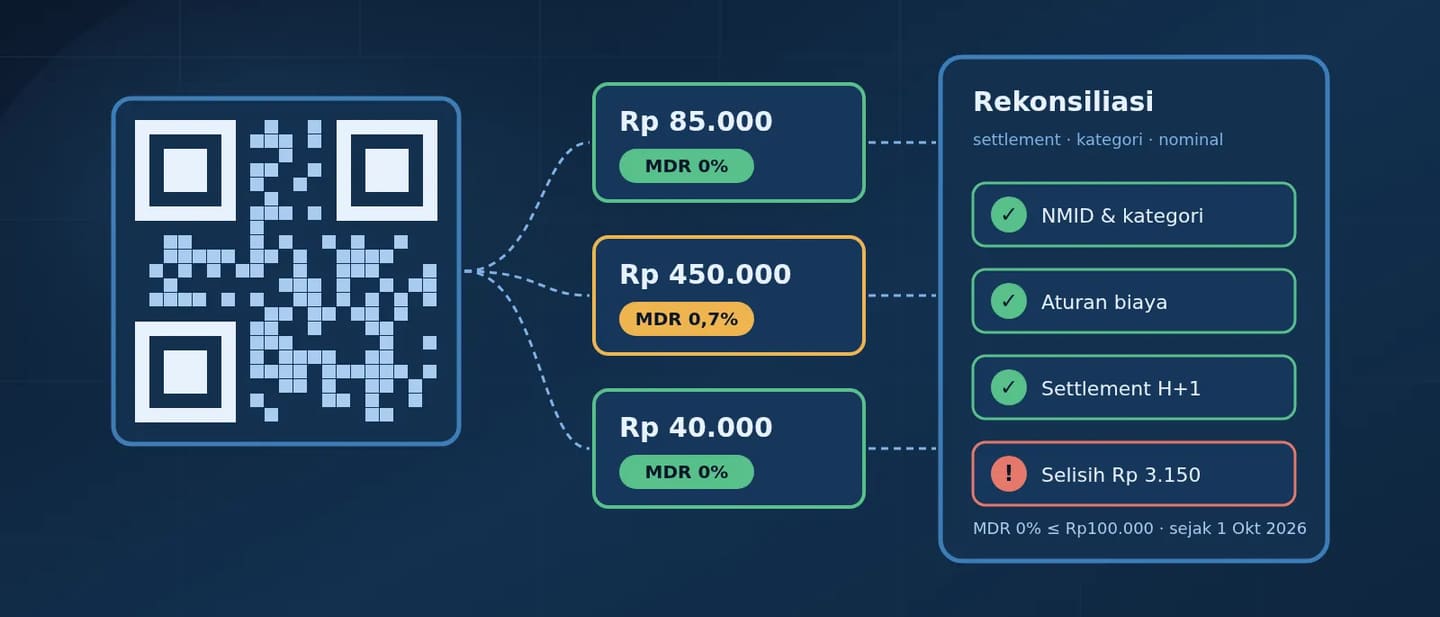
Since 1 October 2026, many organisations have been paying lower QRIS fees without changing anything. On 17 August 2026, Bank Indonesia announced that the QRIS 0% Merchant Discount Rate (MDR) policy would be expanded: 0% MDR continues for micro-enterprise (UMi) merchants on transactions up to IDR 500,000, and now also applies to every merchant category on transactions up to IDR 100,000.
For business owners, that is good news. For finance and operations teams, there is a consequence that is easy to miss: QRIS fees can no longer be calculated with one fixed percentage. The fee now depends on two things at once, the merchant category and the amount of each transaction. Reconciliation rules built on the old assumption can produce false mismatches or, worse, hide real ones.
What changed on 1 October 2026
According to the breakdown published by Kompas.com (19 August 2026), the QRIS MDR structure now looks roughly like this:
| Merchant category |
0% MDR for transactions |
Above the threshold |
| Micro enterprise (UMi) |
up to IDR 500,000 |
0.3% |
| Small, medium, large enterprise (UKE/UME/UBE) |
up to IDR 100,000 |
0.7% |
| Education |
up to IDR 100,000 |
0.6% |
| Fuel stations (SPBU) |
up to IDR 100,000 |
0.4% |
| Public service agencies (BLU), PSO, G2P (e.g. social aid), P2G (e.g. taxes, passports), non-profit donations |
0% |
0% |
Two existing rules still apply. The MDR is borne by the merchant and may not be passed on to consumers, as Bisnis.com explains. QRIS transactions also remain capped at IDR 10 million per transaction, according to Bank Indonesia's QRIS page.
The scale is large. Bank Indonesia reports that by June 2026 QRIS reached 65.77 million users and 44.86 million merchants, 96.68% of them MSMEs. In the first half of 2026 it recorded 12.55 billion transactions worth IDR 1.12 quadrillion, up 93.92% year on year. An economist quoted by Bisnis.com also noted that merchants outside the micro category have many small transactions below IDR 100,000. In other words, the share of transactions affected by the tariff change can be significant, even for hospitals, retail chains, parking operators, or regional state-owned enterprises (BUMD).
Why this is an operations problem, not just a pricing one
In many organisations, QRIS fees enter the books through one simple rule: funds received equal the transaction amount minus a fixed MDR percentage. That rule usually lives in one of these places:
- a reconciliation script or formula in the finance team's spreadsheet;
- an ERP or accounting module that matches the payment provider's (PJP) settlement report against bank statements;
- a billing system, hospital cashier, or levy application that calculates net revenue;
- a dashboard tracking "transaction cost as a percentage of revenue".
After 1 October, a fixed rule like that is wrong for two kinds of transactions: those up to IDR 100,000 (now at 0% MDR) and those above the threshold (still charged by category). If the system still deducts 0.7% from every transaction, reports will show funds "over" what was expected. Teams tired of small differences tend to loosen their tolerance. That looser tolerance is what then hides real problems: delayed settlement, duplicate transactions, or unrecorded refunds.
Five things to check this month
- Merchant category per NMID. Make sure every QRIS code you use is registered with the PJP under the correct category. Organisations with many branches or units often have mixed categories. Units in education or fuel retail have special rates.
- Special status in the public sector. Local governments, regional hospitals (RSUD), and BUMDs should confirm directly with their PJP whether QRIS used for taxes, levies, or BLU/BLUD services falls under the special 0% category. Do not assume; the category list above names BLU and P2G, and the treatment for each NMID should be confirmed in writing.
- Fee rules in your reconciliation system. Replace the fixed percentage with rules based on category and amount. Test the new rules with transaction data from 1 to 12 October, then compare the results with the PJP settlement report.
- Fees passed on to customers. Check POS terminals, checkout pages, and billing systems. If a "QRIS service fee" is still being added for customers, stop and review it, because MDR may not be charged to consumers.
- PJP contracts and reports. Ask your PJP how the tariff change appears in settlement reports, including the per-transaction fee column. Do not split bills just to stay under IDR 100,000 without asking your PJP how that is treated; beyond compliance, the practice complicates audits.
The same policy package also introduced the retail Kartu Kredit Indonesia (KKI) as a QRIS funding source. For merchants, payments still arrive via QRIS, but it is worth making sure your reports and systems do not fail when they encounter a new funding source in transaction data.
A fee reduction that is not reflected correctly in your reconciliation system is not a saving; it is an unexplained difference.
Mapping it to Diagnose, Deliver, and Operate
A change like this is small on paper but touches many systems at once. A phased approach helps:
- Diagnose. Map your payment flows: which PJPs you use, NMIDs and their categories, integration points (POS, billing, ERP, bank statements), and where fee rules are embedded. The result is a list of gaps and priorities, not an immediate new project. If that map does not exist yet, Diagnose is a sensible first step.
- Deliver. Fix the fee rules and the integration with PJP settlement reports against written acceptance criteria. For example: every transaction up to IDR 100,000 is recorded with zero fee, and every settlement mismatch is identified, with its cause, by D+1 at the latest.
- Operate. Monitor daily effective MDR by category and PJP, alert when the figure drifts from the expected pattern, and send a monthly report to finance. This is one example of why Operate differs from ordinary maintenance: the problem is not a server going down, but numbers that slowly drift without anyone noticing.
For the history and scale of QRIS as a national standard, see also our QRIS public case analysis.
Closing
Zero MDR on small QRIS transactions lowers costs for almost every merchant. But the benefit is only fully realised when finance systems calculate fees correctly, differences remain visible, and customers are not charged fees that should not exist. Start with one question: what was your effective MDR in the first week of October, and does that figure match the new rules?
If you want to map your payment and reconciliation flows before year-end closing, schedule a Diagnose session with the MarkasDev team.