On 7 August 2026 the Minister of Communication and Digital Affairs issued Ministerial Regulation (Permenkomdigi) Number 12 of 2026 on Guidelines for Managing Information and Communication Technology Assets of the Electronic-Based Government System (SPBE) and Guidelines for Managing SPBE Services. It was promulgated and took effect on 11 August 2026 (State Gazette of the Republic of Indonesia 2026 Number 556).
For many agencies this is not a distant policy paper. It is operational guidance that closes gaps often left in slide decks: who owns ICT assets, how services are catalogued, and how long an outage may run without a target.
What the regulation covers, briefly
Permenkomdigi 12/2026 implements Article 50(5) and Article 54(8) of Presidential Regulation Number 95 of 2018 on SPBE. It has two interdependent tracks.
SPBE ICT asset management covers hardware and software used in SPBE. The lifecycle has four stages: planning, procurement, operation/management, and disposal. The actors are named: the ICT work unit under the secretariat (or equivalent) in central agencies, and the regional communication and informatics office at province and regency/city level.
SPBE service management covers three processes: user support (complaints, incidents, requests, changes), service operations (running and maintaining SPBE infrastructure and applications), and application management (build and change guided by SPBE methodology). Roles are structured: service sponsor (pembina), accountable owner, service executor, and technical team.
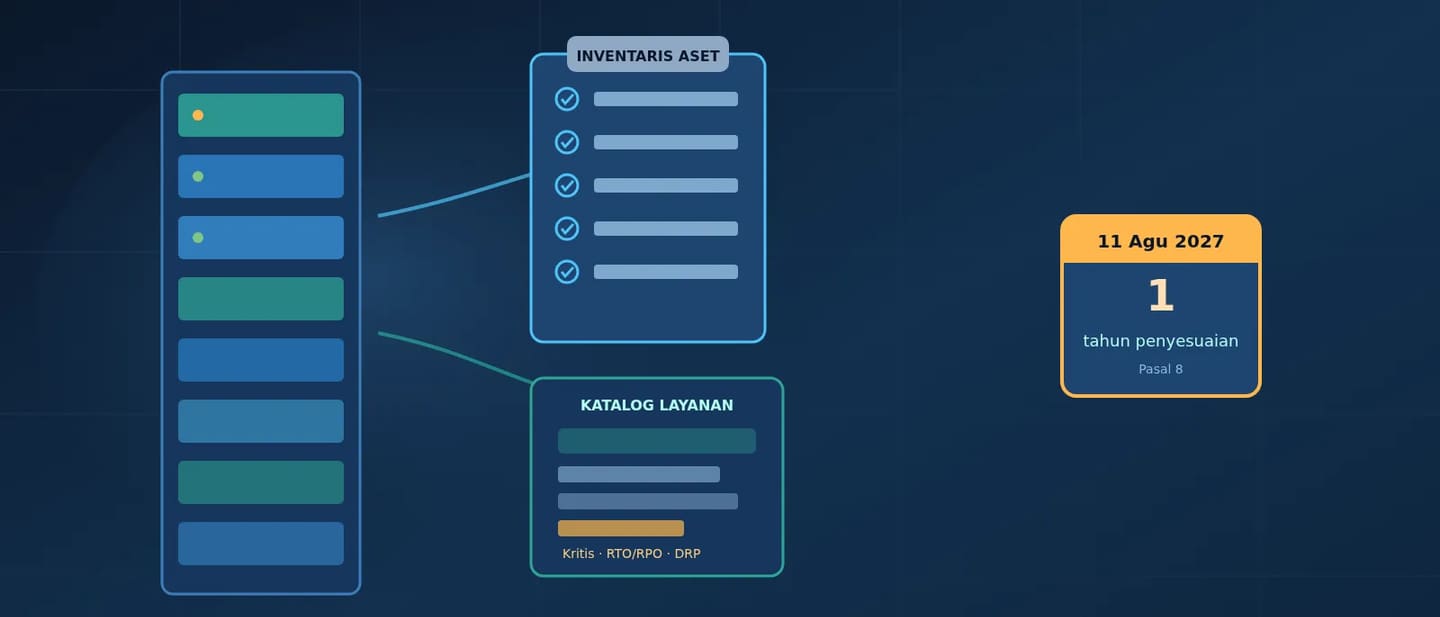
Agencies that already had asset or service management before this regulation must align within one year of promulgation under Article 8. That countdown points to 11 August 2027.
Why a service catalogue beats a list of apps
Annex II requires every service to have a catalogue that at least includes name, description, provider, executor, technical team, access method, availability target, support contact, support hours, fulfilment target, and availability status. The catalogue must be easy for users to reach—not buried in a shared folder opened only before an audit.
Without a catalogue, the helpdesk answers “it depends” and users guess via WhatsApp. With a catalogue, targets become measurable commitments. The guidance even gives example fulfilment targets for common service groups: account services under three hours, application hosting under 14 days, licensed software support under one day. Those figures are examples, not a uniform mandate for every service, but the direction is clear: write the target before the next incident.
Critical classification: RTO, RPO and recovery plans are not decoration
Services are classified as critical, essential, or normal.
- Critical: low outage tolerance; cannot be replaced by a manual process. Must define Recovery Time Objective (RTO) and Recovery Point Objective (RPO), and must have a Disaster Recovery Plan.
- Essential: medium tolerance; may be delayed or run manually for a short time.
- Normal: high tolerance; can be run manually.
Annex examples place national-scale government administration and public services in the critical class. Final classification rests with each central agency and local government based on urgency. What to avoid: labelling almost every application “critical” without RTO/RPO and without a recovery drill. Classification without a recovery plan only adds reporting burden.
Incident-handling targets are also tied to classification. For a major impact on a critical service, the tightest example response time is under 30 minutes with resolution under one hour. Those are priority examples, not SLAs that auto-apply everywhere. The mindset matches sound Operate practice: set priority before the alarm rings.
Asset inventory: from procurement to disposal
On the asset side, the guidance stresses a full lifecycle. Planning must consider service changes, increased use, and availability. Management includes configuration control through the electronic SPBE ICT Asset Management system. Disposal must not become “a dead server in a storeroom with no record.”
Self-monitoring and evaluation must run at least twice a year. Central agencies report results to the Ministry through the electronic system it provides. Regencies/cities report to the province; provinces forward a consolidated report to the Ministry. The Ministry may run an external evaluation at least once a year when needed. The guidance also refers, among others, to SNI ISO/IEC 19770-1 on IT asset management systems.
In short: an inventory that is not maintained is an availability promise you cannot prove.
Six steps you can start this week
- Name the actors in writing. Which ICT unit owns assets; who is sponsor, accountable owner, executor and technical team for services. Without named roles, catalogues and inventories stall.
- Build a living ICT asset inventory. Hardware, software, licences, location, owner, configuration status. Start with assets that underpin public services, not office PCs.
- Write service catalogues with the 11 minimum elements. Publish them where internal users actually look. Link each service to the assets that support it.
- Classify services and complete the critical ones. Write RTO, RPO and a DRP for critical services. A short recovery drill beats a thick document never tested.
- Set incident response and resolution targets. Align them to classification. Connect them to existing complaint channels; do not build a new complaint app if SP4N-LAPOR! or an internal service desk is already the official path.
- Schedule self-evaluation twice a year. Reports should include findings, success measures for fixes, and a follow-up plan. That matches security by design in SPBE: controls before go-live, not after inspection.
What this means outside central government
Regional SOEs (BUMD), regional hospitals and partners that run public services often share assets and applications with the parent SPBE. Your Operate contracts should reflect service classification, availability targets and inventory duties. A vendor that only “fixes when it breaks” is not enough for critical services; we contrast that in Maintenance vs Operate.
If you are purely private sector, the guidance is still a useful checklist: service catalogues, critical classification, RTO/RPO and asset lifecycle are foundations of operational reliability anywhere.
MarkasDev’s role
MarkasDev is a Technology Partner for operational reliability, not a software house selling features.
- Diagnose: map asset inventories, catalogue gaps, critical services without a DRP, and readiness for self-evaluation before the 11 August 2027 deadline.
- Deliver: build system and API integration, catalogues linked to inventories, and change/recovery procedures with milestones and written acceptance criteria.
- Operate: retainer with SLA and monitoring via Operate, including server and environment care and periodic recovery drills.
If your SPBE asset inventory and service catalogue still live in separate spreadsheets, book a Diagnose session before the August 2027 countdown gets shorter.
Sources
- Full text of Permenkomdigi Number 12 of 2026 (JDIH BPK PDF): https://peraturan.bpk.go.id/Download/417633/permenkomdigi-no-12-tahun-2026.pdf
- JDIH BPK metadata page (issued 7 August 2026, promulgated/effective 11 August 2026, BN 2026/556, 71 pages): https://peraturan.bpk.go.id/Details/353730/permenkomdigi-no-12-tahun-2026
- Presidential Regulation Number 95 of 2018 on the Electronic-Based Government System (Articles 50(5) and 54(8) implemented by this ministerial regulation)