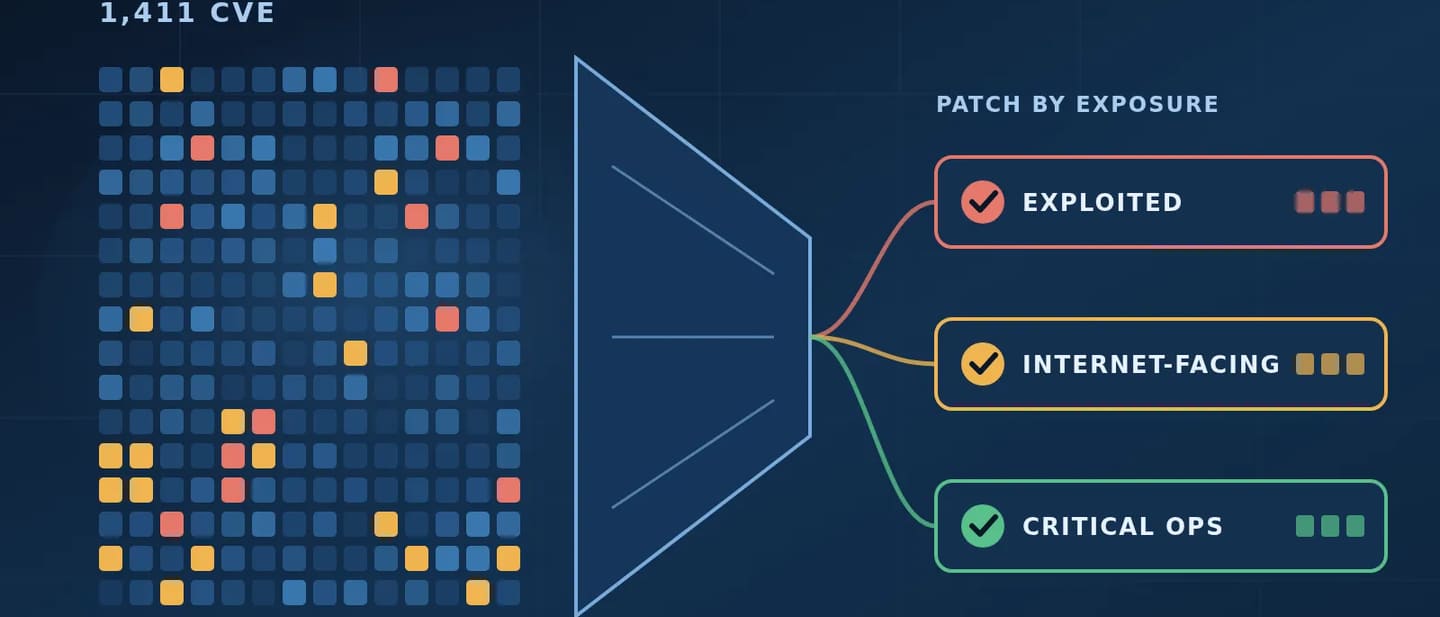
On 13 October 2026 Microsoft shipped a monthly security release that BleepingComputer called record-breaking: 1,411 flaws fixed in a single Patch Tuesday, including one actively exploited and two publicly disclosed zero-days. That count does not even include 348 other flaws fixed earlier in the month, in services such as Azure and Exchange Server.
For operations leaders, the more useful question is not "how many flaws?" but "does the way our team chooses patches still make sense at this volume?" This month Microsoft itself started answering that question with a new approach it calls risk cohorts.
What happened this month
According to BleepingComputer's summary, the October release contains 70 Critical flaws, 57 of them remote code execution. Elevation of privilege (677) and remote code execution (317) dominate the mix. The actively exploited zero-day, CVE-2026-96951, lets attackers bypass the Mark of the Web feature in Windows Shell, the marker that normally triggers a warning when a file comes from the internet.
Two deadlines landed on the same day. Windows 11 version 24H2 Home and Pro, and Windows 10 Enterprise LTSB 2016, reached end of updates; the October release is the last security update for those editions. Microsoft also warned that Windows 11 23H2 Enterprise, Education, and IoT Enterprise editions stop receiving security updates from next month.
Outside Microsoft, the same week was busy with active exploitation. Safe Security's weekly report noted that an Atlassian Data Center flaw (CVE-2026-21589) was exploited within hours of technical details going public, self-managed GitLab was still being attacked through a path traversal flaw, and internet-exposed AhsayCBS backup servers were compromised to the point of web shells and crypto miners.
Volume is not the signal; exposure is
Safe Security's data for the same week helps put the record number in context. Of 3,522 CVEs published, 1,415 were rated critical or high and 516 already had public exploit or proof-of-concept code. Yet only 16 CVEs showed real exploitation signals, and 14 of those were older flaws, not newly disclosed ones.
In other words, a target such as "all critical flaws closed within X days" is no longer enough. Risk is decided by the overlap of three things: the flaw is being exploited, the system is reachable by an attacker, and the system matters to operations. Safe Security stresses that an SSRF in a remote-access appliance or a disruption of an authentication gateway can be as serious as code execution, because those devices sit in the access path of many other services.
Microsoft had already signalled this in its May 2026 MSRC note: releases are expected to keep growing as AI speeds up vulnerability discovery, both inside Microsoft and among external researchers. Its advice is direct: triage by exposure and impact, not raw count; use the full set of signals in the Security Update Guide (Exploitability Index, public exploit code status, observed exploitation); reduce internet-facing systems; tighten identity; and be ready for more frequent out-of-band updates.
Risk cohorts: answer the environment question once
Alongside the October release, MSRC published the risk cohort concept. The idea is simple: many CVEs force analysts to answer the same questions about their environment. Can untrusted content reach this component? Who can run code across the privilege boundary? Is this role or feature actually deployed?
Microsoft grouped this month's CVEs into 15 cohorts. The three largest are Windows filesystems, storage, and backup (136 CVEs), Office document and mail clients (135 CVEs), and Windows graphics and media processing (131 CVEs). There are also cohorts for remote access and RDP (65 CVEs) and for directory, federation, and certificate infrastructure (24 CVEs).
| Cohort (MSRC example) |
Question answered once |
| Remote access & RDP |
Which hosts are RDP gateways/servers, and are they reachable from outside? |
| Office documents & mail |
Who opens documents/mail from outside parties, on which versions? |
| Filesystems, storage, backup |
Which backup paths accept images, media, or untrusted input? |
| Directory & certificates |
Which domain/federation/enrolment services are enabled and reachable? |
Microsoft is clear about the limits. Cohorts are exploratory, not official categories, do not change update guidance, and do not set priority on their own. A cohort also does not mean one update closes every CVE in it. Once the environment question is answered, each CVE is still judged on exploitation status, severity, attack vector, required privileges, and whether user interaction is needed.
Virtual patching buys time; it does not replace patching
On the same day, Broadcom introduced VMware HyperArmor at VMware Explore in Frankfurt, as reported by SiliconANGLE. It provides virtual patching at the ESX host level, restricts which programs and scripts may run, and adds MFA for SSH access to hosts. Broadcom says the protection needs no reboot or upgrade, giving teams time to test the official patches.
The comment from Broadcom engineer Eric Chien is worth noting: still patch, because virtual patching only buys time. That principle applies widely. A WAF, an IPS rule, or an access restriction is a legitimate temporary control, as long as it is recorded, has a deadline, and is followed by the real patch.
What this means for organisations in Indonesia
Many organisations in Indonesia, from local governments and regional SOEs to hospitals and local financial institutions, still run Windows Server, Active Directory, Exchange, RDP, and on-premise applications looked after by a small team or a vendor. A denser patch rhythm will be felt most there. Five practical steps:
- Build an inventory that answers the cohort questions. An asset list alone is not enough. Record what faces the internet (RDP gateways, VPNs, portals, self-managed GitLab/Atlassian, backup servers), who owns it, and its OS version. This is typical Diagnose-phase work.
- Check end-of-support dates now. Windows 11 24H2 Home/Pro devices receive no updates after October 2026, and 23H2 Enterprise/Education stops from November. Staff laptops bought with Pro licences often slip off the list.
- Set patch SLAs based on exposure. For example: actively exploited flaws on internet-facing systems are handled within days; the rest follows a tested monthly cycle. Write down the acceptance criteria, including functional checks after patching, as in the Deliver phase.
- Treat backup servers and gateways as first-class assets. The AhsayCBS case shows that exposed backup can become an entry point. We covered a related lesson in servers back up is not business recovered.
- Record every temporary mitigation. If a patch must wait because of a legacy application, document the compensating control, its owner, and its expiry date, then review it in the monthly operations meeting.
Steps 3 to 5 are a routine rhythm, not a one-off project. This is where an Operate retainer or a servers-and-environments service fits: scheduled patching, verified backups, monitoring, and reports that leadership can read. We explain the difference between "fix it when it breaks" and a run-and-watch operation in Maintenance vs Operate.
Closing
A record 1,411 flaws is no reason to panic, but it is a reminder that a patch process designed for the volumes of five years ago needs a review. Start with the simplest question: which systems can an attacker reach today, and who is responsible for updating them?
If you are not sure of the answer, book a Diagnose session to map your assets, exposure, and a patch rhythm your team can realistically keep.
Sources
- BleepingComputer, "Microsoft October 2026 Patch Tuesday fixes 1,411 flaws, 3 zero-days" (13 October 2026).
- Microsoft Security Response Center, "Using risk cohorts to prioritize security updates" (13 October 2026).
- Microsoft Security Response Center, "A note on this month's Patch Tuesday" (12 May 2026).
- Safe Security, "This Week in CVEs: Exploitation Expands Across Backup, Remote Access, and Developer Infrastructure" (13 October 2026).
- SiliconANGLE, "Broadcom adds hypervisor protection to VMware" (13 October 2026).