In the past two weeks, the largest vendors have raced to put AI agents into the workplace. On 25 September 2026, Microsoft brought Chat, Cowork, Code, and Autopilot together in one Copilot, with a unified plugin registry and cost controls for agentic workloads, according to InfoWorld. Four days later, OpenAI introduced dots, always-on agents that can connect to more than 4,000 apps through its plugin ecosystem, including a preview of specialist dots with their own identity and credentials inside an organisation.
For leaders and operations managers, the important question is not which agent is smartest. It is this: once agents start connecting to your core systems, which standard do those connections use, and can you still switch vendors without rebuilding everything?
AI agents can be replaced in a matter of weeks. Integrations into core systems usually last for years. The integration layer is what you need to protect.
What happened: two agent standards, one home
Two open protocols come up most often in conversations about AI agents.
- Model Context Protocol (MCP) defines how an agent connects to tools, data, and applications.
- Agent2Agent (A2A) defines how agents from different frameworks or vendors discover each other, hand off tasks, and exchange results.
On 17 August 2026, the Agentic AI Foundation (AAIF), hosted by the Linux Foundation, announced that A2A was joining as a hosted project, alongside MCP, AGENTS.md, goose, and agentgateway. The official A2A blog says A2A was accepted as a Growth Stage project.
Some facts from those two sources:
- Google launched A2A in April 2025 and donated it to the Linux Foundation with founding organisations such as AWS, Cisco, Microsoft, Salesforce, SAP, and ServiceNow.
- A2A v1.0, the first stable specification, shipped in March 2026, adding version negotiation, multi-tenancy, and signed agent cards for cryptographic identity verification.
- A2A is backed by more than 150 organisations. Google Cloud, Azure AI Foundry, and AWS Bedrock AgentCore already support it.
| Layer |
Standard |
Question it answers |
| Agent to tools and data |
MCP |
How does an agent read and use your systems? |
| Agent to agent |
A2A |
How does vendor A's agent hand a task to vendor B's agent? |
| Traffic and control |
agentgateway |
Where do routing, policy, and observability sit? |
| Project instructions |
AGENTS.md |
How are working rules passed to agents? |
MCP 2026-07-28: a standard willing to change
On 28 July 2026, the MCP maintainers released specification version 2026-07-28. They reported close to half a billion monthly downloads across the Tier 1 SDKs. The changes most relevant to organisations:
- A stateless protocol core. Protocol-level sessions and the initial handshake are gone, so any request can be served by any server instance behind a plain load balancer.
- Required `Mcp-Method` and `Mcp-Name` headers. Gateways, rate limiters, or WAFs can route and authorise requests without parsing the JSON body.
- Hardened authorisation. Clients must validate the
iss parameter (RFC 9207), credentials are bound to the authorisation server that issued them, and Dynamic Client Registration is deprecated in favour of Client ID Metadata Documents. - A formal deprecation policy. Deprecated features keep working for at least 12 months. Roots, Sampling, and Logging are now deprecated; the changelog suggests logging to
stderr or using OpenTelemetry instead.
The MCP maintainers are open about the cost: there is migration work, especially for developers who relied on session identifiers.
On 14 September 2026, the Linux Foundation launched the MCPA certification. The second-largest share of the exam, 24 percent, is security and governance. That signals that trust boundaries, permissions, and risk controls are treated as core competence, not an add-on.
Facts, interpretation, and limits
The fact is that agent standards are now run by a neutral foundation, and the specifications are mature enough for production use. Our interpretation: this lowers one specific risk, a protocol that follows a single vendor's product decisions.
But an open standard does not automatically make you free to move. Business rules, context data, permissions, and an agent's work history still live in the platform you choose. The latest MCP release also shows that even a standard can change fundamentally. The difference is that such changes now come with a clear window, so they can be planned.
What it means for organisations in Indonesia
Many organisations in Indonesia, from local governments and hospitals to rural banks and logistics companies, will meet AI agents through products they already use, not through a dedicated AI project. That means architecture decisions are often made without anyone noticing. Six practical steps help you keep control.
- Inventory every agent connection. List the AI tools already connected to email, documents, ERP, hospital information systems, core banking, or warehouse systems. For each connection, record whether it uses MCP, a vendor-specific plugin, or a custom API, and who owns the credentials. This is Diagnose work, and it usually uncovers more connections than anyone had on record.
- Put standards into procurement documents. Ask which MCP and A2A versions are supported, whether agent configurations can be exported, and whether agent identities can be managed through your own identity system.
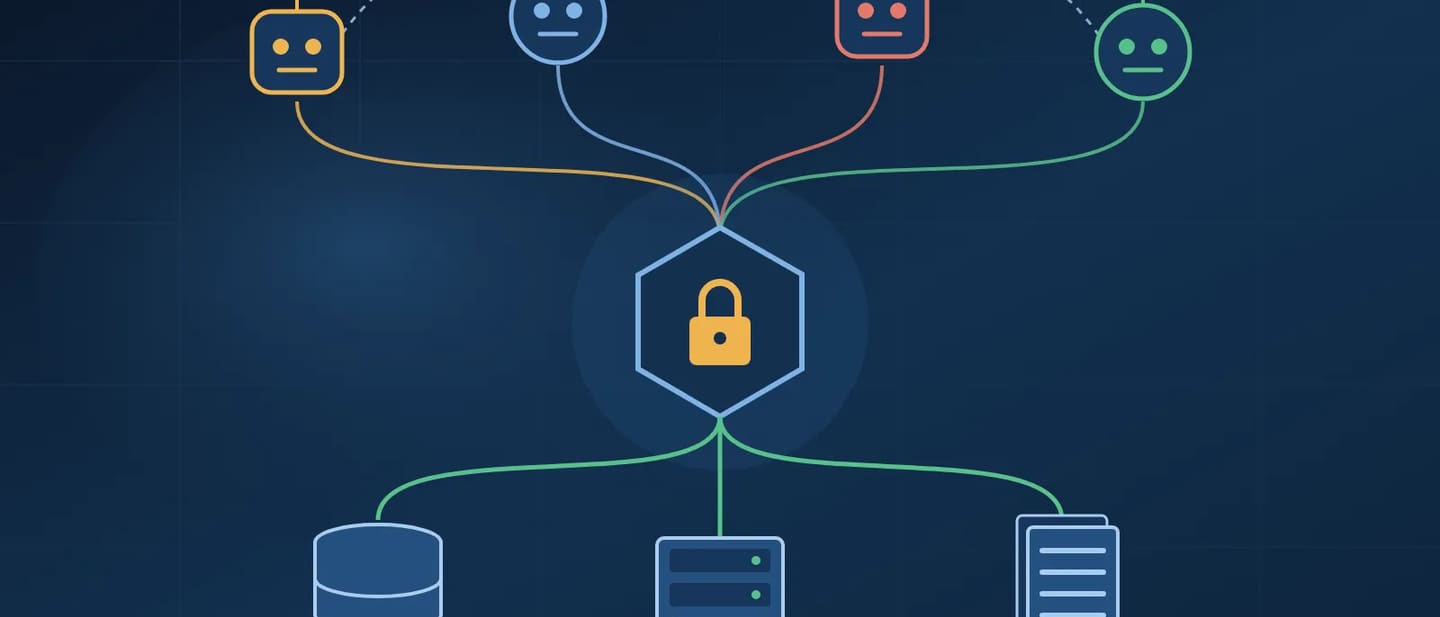
- Own your integration layer. Expose core systems through APIs or MCP servers you manage, behind a gateway with authorisation and logging. Agents from any vendor go through the same door. This is the core of our systems and API integration service.
- Write testable acceptance criteria. In Deliver, example criteria are: agents from two different vendors can use the same MCP server without code changes, every tool call is logged with the agent's identity, and
iss validation is enabled. - Track versions and deprecation windows. In Operate, record the specification and SDK version behind every connection, set reminders before the 12-month window closes, and move logging to OpenTelemetry.
- Keep access limited. Standards make connecting easier, not safer. The least-privilege principle we covered in AI agents need access limits still applies.
How MarkasDev helps
- Diagnose: map agent connections and core systems, then set out architecture decisions and procurement criteria.
- Deliver: build the integration layer or MCP servers in milestones with written acceptance criteria, as part of our AI implementation service.
- Operate: monitor gateways, logs, specification versions, and usage costs under an agreed SLA.
If your organisation is starting to use AI agents and wants to avoid being locked into one vendor, request a Diagnose through our contact page. We start from the connections you already have, not from a vendor choice.
Sources