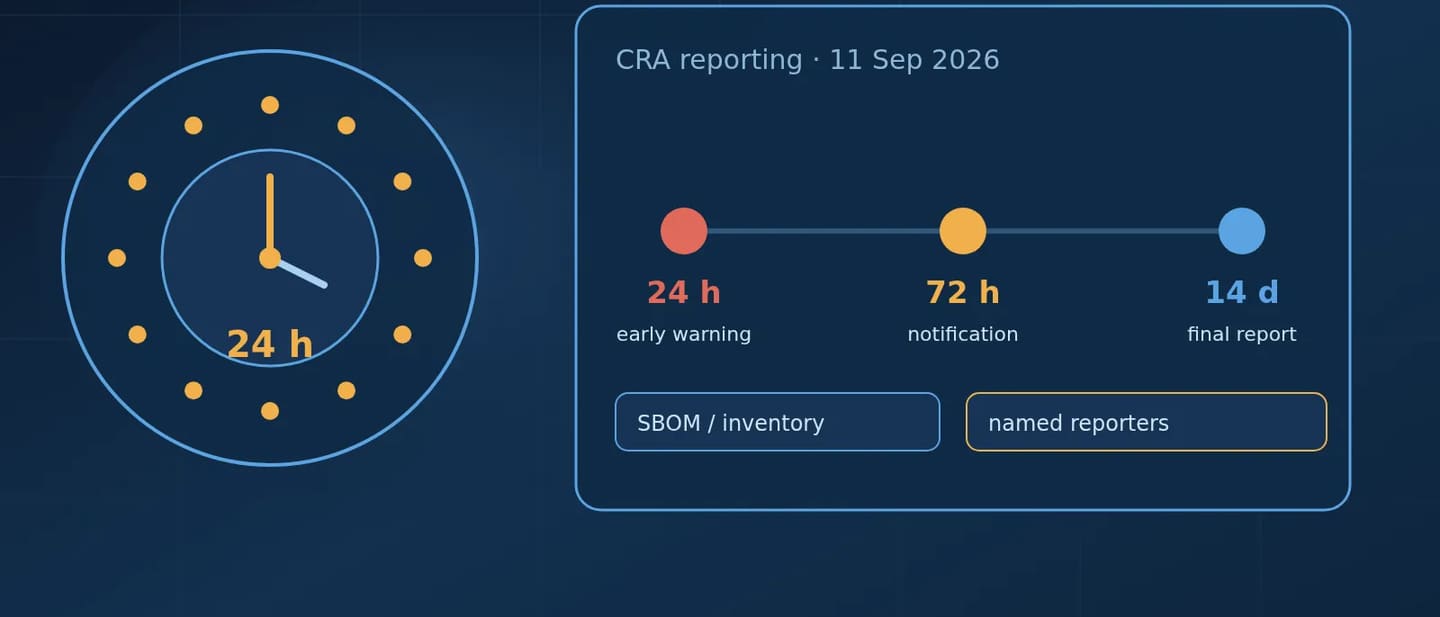
Since 11 September 2026, a clock has been running officially for software makers in the European Union: 24 hours. Manufacturers of digital products sold there must now send an early warning to the authorities within 24 hours of learning that a vulnerability is being actively exploited. The law is the Cyber Resilience Act (CRA), and this reporting duty is the first part that is already in force.
You may think this is a European matter. Partly, yes. But the way the rule works—a component inventory, a named person in charge, an escalation path you can prove—is a pattern that customers, partners, and auditors will soon ask for everywhere, including in Indonesia. This article summarises what actually changed, based on official European Commission and ENISA sources, and turns it into realistic next steps.
A 24-hour deadline cannot be met with goodwill. Only organisations that already know what their product contains, who decides, and which channel carries the report can meet it.
What started on 11 September 2026
According to the European Commission's official page on CRA reporting obligations, manufacturers of products with digital elements must report two things: actively exploited vulnerabilities, and severe incidents affecting product security. Reporting goes through a single door, the Single Reporting Platform (SRP) run by ENISA, the EU cybersecurity agency. ENISA's press release of 11 September 2026 states that the platform went live the same day.
The reporting rhythm has three stages:
- Early warning—without undue delay and within 24 hours of the manufacturer becoming aware.
- Notification—within 72 hours, with general information and an initial assessment.
- Final report—within 14 days after a fix or mitigation is available (for vulnerabilities), or within one month of the 72-hour notification (for severe incidents).
One report is enough. It goes to the coordinating CSIRT in the relevant member state and, at the same time, to ENISA; that CSIRT passes it on to other countries where the product is available. In exceptional circumstances justified on security grounds, dissemination can be delayed.
Other obligations come later
Do not conclude that the whole CRA is already in force. ENISA says the main cybersecurity requirements apply from 11 December 2027. Reporting duties for open-source software stewards also start on that date, to the extent that they are involved in developing products with digital elements. So what is mandatory today is reporting by manufacturers.
Practical details that are easy to miss
ENISA's SRP FAQ (updated 30 September 2026) contains several points that decide whether your process runs smoothly or stalls:
- Personal accounts with MFA. A manufacturer's representatives must use personal EU Login accounts with multi-factor authentication. One manufacturer has one primary representative and up to 20 secondary ones. In other words, do not wait for an incident to decide who is allowed to press submit.
- No API yet. In the initial release, notifications must be entered through the platform interface. Automation is only possible on your own side.
- English only at launch.
- Choosing the wrong CSIRT can invalidate a report. If a manufacturer has no main establishment in the EU, the FAQ sets out an order for choosing the country: where the authorised representative acts, then the importer, then the distributor, then the country with the most users.
- It covers older products. Article 14 duties apply to all products in CRA scope, including those placed on the market before 11 December 2027. However, a manufacturer is not required to report retroactively an exploitation it already knew about before 11 September 2026.
- One report per event, even if the company has several branches or its parent sits outside the EU. Internal coordination is the manufacturer's responsibility.
What this means for organisations in Indonesia
This section is our own interpretation, not a quote from the regulation.
If you build or sell digital products to the European market—software, firmware, IoT devices, or services bundled into a product—check whether you count as a "manufacturer" under the CRA. The ENISA FAQ explicitly covers manufacturers without a main EU establishment, so being based in Jakarta or Surabaya does not automatically exempt you. Confirm scope with legal counsel; we do not give legal opinions.
If you only buy and use products—hospitals, local governments, regional enterprises, regional banks, logistics firms—the direct effect is subtler. Suppliers that sell into Europe will have a more disciplined reporting process, and you should ask whether the same process applies to customers in Indonesia. That question can go into contracts and SLAs.
If you are a developer assembling products from many components, the lessons of the Axios npm case apply directly. The Commission and ENISA point questions about third-party components to the CRA guidance, but the prerequisite is clear: without a current component list, you cannot tell whether a newly exploited vulnerability sits in your product.
The same pattern is already familiar at home. In early September, a BSSN official said that about 25 percent of the 2,855 potential-incident notifications sent in 2025 had not been adequately followed up. Detection without a rehearsed response does not help. The CRA enforces that response discipline with a running clock.
Five steps you can start this week
- Map your products and role. Which products have digital elements, where they are sold, and whether you are a manufacturer, importer, or just a user.
- Build a component inventory. At minimum, a list of dependencies and versions per release, so "are we affected?" is answered in hours, not days.
- Name and train your reporting representatives. Set up accounts, backups, and a decision on who may declare a vulnerability "actively exploited".
- Write a 24-72-14 runbook. What is sent at hour 24, hour 72, and after the patch; who approves; and where the time you "became aware" is recorded.
- Rehearse once. A two-hour tabletop exercise usually exposes more gaps than three policy meetings.
In our framework, steps 1 and 2 are Diagnose work: clarifying the situation, risks, and options before budget is locked in. Steps 3 to 5 become part of Operate if the organisation wants the process kept watched and monitored once it is running.
Limits to keep in mind
This article is not legal advice and does not cover the whole CRA. We only rely on the European Commission's official page, ENISA's press release and FAQ, and BSSN statements as reported by the media. The definitions of "actively exploited" and "severe incident", and the handling of third-party components, depend on the Commission's guidance; read section 9.1 of that guidance before finalising a procedure.
Start with a mapping
If you are unsure whether your products or suppliers are affected, start with a short, time-boxed mapping. We deliver written findings: which products need attention, what to prepare, and who owns it. Request a Diagnose via the contact page.
Sources
- European Commission—Cyber Resilience Act, reporting obligations: https://digital-strategy.ec.europa.eu/en/policies/cra-reporting
- ENISA—press release on the launch of the CRA Single Reporting Platform (11 September 2026): https://www.enisa.europa.eu/news/the-cra-single-reporting-platform-is-launched
- ENISA—CRA Single Reporting Platform FAQ (updated 30 September 2026): https://www.enisa.europa.eu/topics/product-security/single-reporting-platform-srp/frequently-asked-questions
- Diksiber DKI—BSSN urges data centre operators to strengthen cybersecurity (2 September 2026): https://dki.diksiber.id/pemerintah/bssn-desak-pengelola-data-center-perkuat-keamanan-siber-ancaman-kini-sasar-fondasi-infrastruktur-digital-nasional/