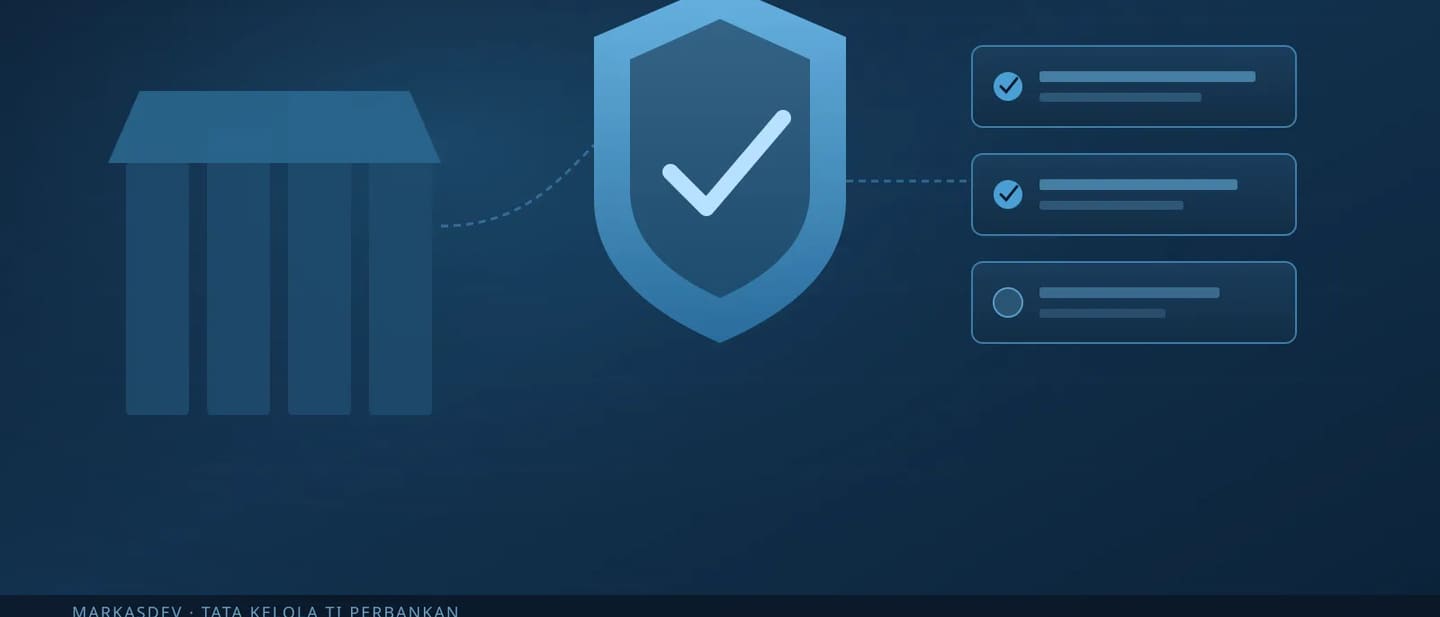
For operations leaders at commercial banks and BPR/BPRS, 2026 brings two different clocks for IT governance. OJK PADK Number 1 of 2026 for commercial banks has been in force since 1 March 2026. POJK Number 34 of 2025 for rural banks (BPR) and sharia rural banks (BPRS) takes effect around 18 December 2026—less than three months away if you are reading this in early October.
Neither instrument starts from a blank page. PADK 1/2026 sharpens the implementing detail of POJK 11/POJK.03/2022 on IT operations for commercial banks and repeals SEOJK 21/SEOJK.03/2017. POJK 34/2025 replaces POJK 75/POJK.03/2016 (and its circular) so BPR/BPRS IT governance, risk management, and cyber resilience match today’s digital exposure.
Banking IT rules in 2026 are not about buying another tool. They are about who decides, who owns third-party TI risk, where data is processed, and how operational resilience is tested before an audit or an incident.
This article summarises what we can verify from the PADK 1/2026 regulation page, OJK abstract, PADK FAQ, POJK 34/2025 page, POJK 34/2025 FAQ, and OJK press release—then turns it into a practical checklist. It is not legal advice and does not claim MarkasDev replaces your internal compliance function.
What changes for commercial banks under PADK 1/2026
Per OJK’s abstract and FAQ, the PADK was issued on 23 January 2026 and took effect on 1 March 2026. It provides technical guidance under POJK PTIBU, including:
- IT governance: roles and responsibilities of the Board of Directors, Board of Commissioners, IT steering committee, and the IT unit.
- IT architecture and strategic IT plans: a process aligned to business direction, not a one-off archive document.
- IT risk management: including information and communications-network security.
- IT service providers (PPJTI): policies and procedures, use of PPJTI outside Indonesia, and reassessing materiality.
- Licensing for placing electronic systems and TI-based transaction processing outside Indonesia.
- Data management and personal-data protection—overlapping the national PDP agenda, through a banking lens.
- Banks providing TI services, internal control and audit, and reporting.
Versus SEOJK 21/2017, OJK’s FAQ highlights adjustments on PPJTI, standards when the bank itself provides TI services, internal control, report/permit formats, plus added detail on governance, architecture, data/PDP, and filing procedures. Secondary reporting that quotes OJK, such as Bisnis.com coverage, also lists those nine clusters. The long technical annex (Lampiran I) holds the detail; for ops leaders, the practical bar is clear roles, decision trails, and evidence that third-party risk and data residency are not floating.
The POJK 34/2025 countdown for BPR and BPRS
POJK 34/2025 was issued on 16 December 2025, promulgated on 17 December 2025, and takes effect one year after promulgation—18 December 2026. When it applies, POJK 75/POJK.03/2016 is repealed. OJK also issued implementing detail via PADK 43/PADK.03/2025 (noted in the January 2026 press release).
The POJK 34/2025 FAQ summarises the main scope: Board and unit authorities for IT; risk management including information security; placing electronic systems in data centres and disaster-recovery sites in Indonesia; IT architecture for BPR/BPRS with digital services; and cyber resilience and security. For PPJTI already in use before the rule applies, alignment happens after the current cooperation agreement ends—that is not permission to delay inventory work.
For BPR that rely on external core banking or managed services, the practical implication is: contracts, SLAs, data location, audit access rights, and vendor exit plans must be readable by the Board before December 2026, not after an OJK letter arrives.
A practical checklist for operations leaders
1. Map IT roles and decisions
Record who sets IT policy, who approves material budgets/projects, who monitors risk, and who reports to the board. If “everything sits with IT” with no Board/committee trail, the governance gap is already visible before auditors arrive.
2. Inventory PPJTI and materiality
List cloud, core, channel, SOC, statement printing, and API integration vendors. Mark what is material: impact on customer service, sensitive data, or operational resilience. Plan materiality reassessment under bank policy—not only at annual renewals.
3. Data location, DR, and offshore processing
For commercial banks: separate workloads that need permits when systems or TI-based transaction processing sit outside Indonesia. For BPR/BPRS: ensure data centres and DR are in-country under the POJK 34 frame. Do not assume “nearest cloud region” automatically meets the requirement without a compliance review.
4. Cyber resilience you can test
Detection, response, and incident reporting need owners and runbooks—not only tools. A short tabletop exercise beats a thick document that has never been run.
5. Data and PDP on the operating path
Join banking duties with personal-data protection: classification, vendor access, retention, and breach escalation. See also the frame in our PP 33/2026 countdown so teams do not run two colliding programmes.
6. Evidence, not slides
Keep committee decisions, vendor due diligence, DR test proof, and critical change logs. When reporting or permits are required, OJK formats apply—your internal process must already produce the raw material.
Mapping to Diagnose, Deliver, and Operate
| Phase |
Core question |
Written output |
| Diagnose |
Which PPJTI are material? Where is data processed? Who owns IT risk? |
Vendor map, governance gaps, priority options |
| Deliver |
What acceptance criteria cover contracts, access control, DR, and logging? |
Milestones with compliance gates before go-live |
| Operate |
Who watches vendor SLAs, incidents, and config change? |
Review cadence, runbooks, escalation |
A Diagnose phase fits when the PPJTI inventory and data locations are still unclear—cheaper than renewing a large contract without written criteria. In Deliver, put security controls and audit trails into acceptance criteria, especially for system/API integration and server environments. After go-live, Operate keeps monitoring and controlled change so compliance does not evaporate by month three.
For local finance institutions and BPR, see our Finance & rural banks sector context. If architecture decisions still swing every quarter, IT consulting with written outputs—or the Diagnose–Deliver–Operate approach—keeps the discussion on evidence, not vendor preference. Related reading on security before go-live: security by design.
Realistic first steps this week
- Print the active PPJTI list + contract end dates + data/DR locations.
- Name a single management owner for IT policy and incident reporting.
- For commercial banks: check any offshore system placement or TI-based processing that needs a permit or review.
- For BPR/BPRS: mark gaps on in-country data centres/DR and cyber resilience before December 2026.
- Schedule one 90-minute incident tabletop with IT, operations, and compliance.
If you want to map IT-governance gaps and PPJTI risk before budgets or vendor renewals lock in, start with a Diagnose conversation — or read what Diagnose includes first. You get a written map and decisions your internal team can use, with or without us.